Münchner Genuss-Arena: The Micro-Theater of the Nocturnal Kiosk
Analyzing how the Flâneur observes Munich's isolated islands of light from the deep, atmospheric shadows.
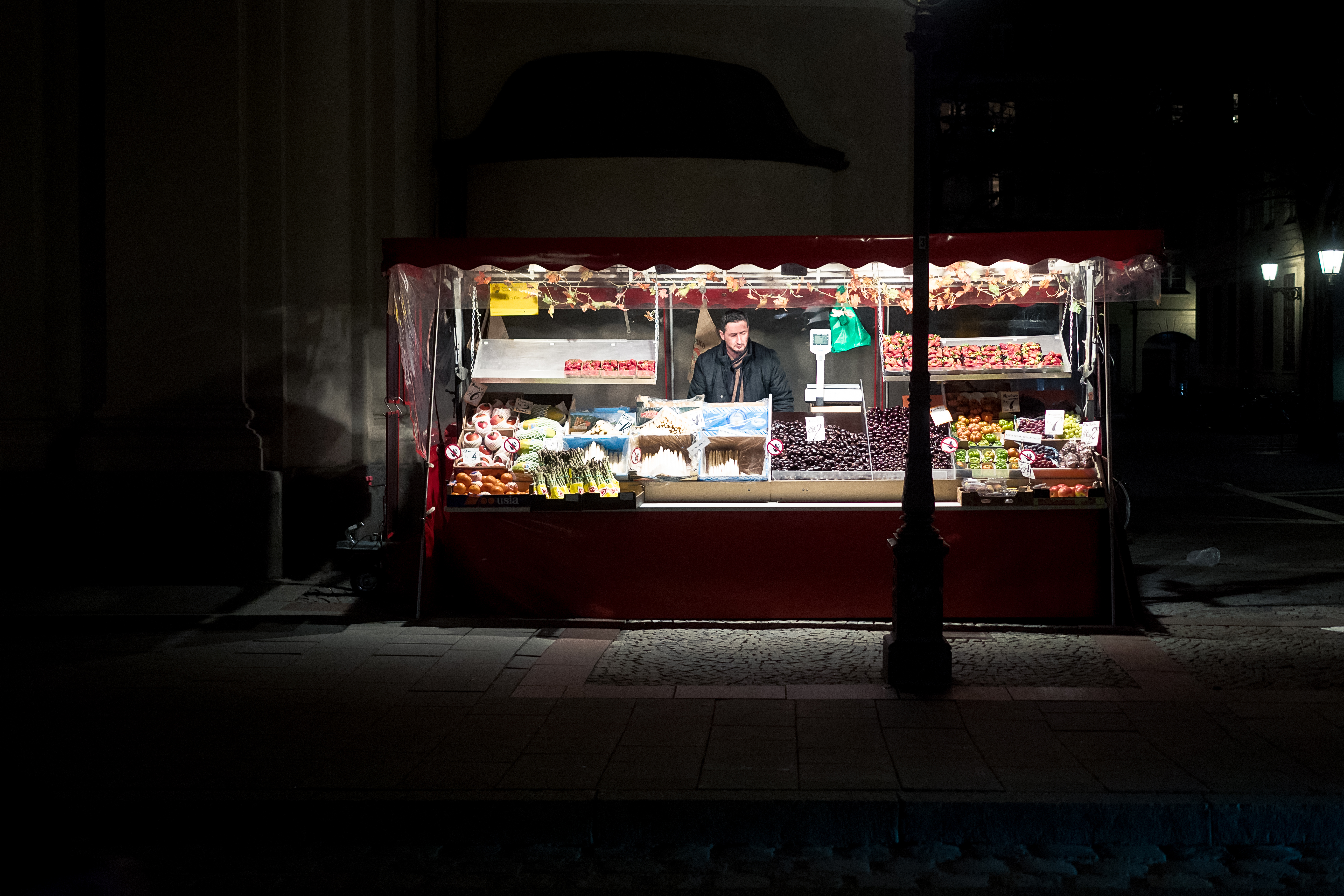
The core philosophy of the Flâneur Method is not about chasing subjects; it is about finding the right operational boundaries and letting the theater of the street organize itself within them. There is perhaps no better operational anchor for this approach than the isolated night kiosks of Munich. These scattered islands of warm light act as illuminated stages, drawing pedestrians in while the surrounding city contracts into atmospheric darkness.
Consider the wide perspective of a nocturnal Munich street. The scene is dominated by deep, featureless void—the classic Munich cobblestone alleys and the historic facades are all but lost to the night. In this specific environment, the Gassen & Genuss kiosk doesn't just trade in fresh produce; it behaviorally manages the street.
Kostenloser Leitfaden: Street Photography auf Deutsch
Möchten Sie die Methoden der stillen Beobachtung direkt in deutschsprachigen Städten anwenden? Laden Sie unseren kostenlosen Gumroad-Kurzleitfaden herunter und lernen Sie die Grundlagen der Geometrie-Framing-Technik.
Kostenlosen Leitfaden herunterladen (PDF) →The Flâneur's Anchor Point: Shadow vs. Highlight
Traditional, aggressive street photography demands that you get close to the vendor or the customer. The Flâneur Method, however, exploits the geometry of the entire environment. Looking at the wider perspective, the Flâneur establishes an operational anchor point in the deep shadows across the cobblestone pavement, perhaps 10 or 15 meters away. You are completely invisible.
This wide viewpoint allows you to observe how the human element interacts with the rigid geometric structure of the kiosk. By keeping the framing boundaries loose enough to include the distant street lamps, you construct a sense of urban expanse and solitude that a close-up snapshot completely misses. You don't have to 'hunt' the moment; you designed the moment by stabilizing the framing first.
Explore the Geometry Framework
Learn how to use environmental scale, shadow management, and local architecture to completely remove street anxiety.
View Masterclass ToolkitsThe Chronological Trace
This wide perspective captures the invisible pathways that city commuters trace at night. When you stand near the kiosk, your presence might disrupt these paths. But when you apply the Flâneur Framework from the deep shadows, you observe how pedestrians naturally gravitate toward the light arena—tracing unique, organic lines across the ancient cobblestones. It is a slow, methodical approach that yields deeply structured, cinematic images of urban loneliness and transaction.